





Coal ash
Contents |
[edit] Introduction
Coal ash is a material produced during the combustion process at coal-fired power stations. It can be used in a range of construction products with little need for further refinement, such as fillers, cement, grouts, blocks, and so on.
In the UK, the types of available coal ash are as follows:
- Pulverised fuel ash (PFA).
- Furnace bottom ash (FBA).
- Cenospheres.
Different coal ash-based products will have varying moisture content, degree of compaction, shear strength, and so on. They are categorised according to a number of industry standards setting out the levels of coal ash contained in particular products and what they can safely be applied to. For example, BS EN450-1 provides the specifications and categories for PFA use in concrete and BS EN450-2 defines quality control and statistical compliance.
[edit] Pulverised fuel ash
Pulverised fuel ash (PFA), also known as fly ash, is a very fine ash that results from burning pulverised coal in coal-fired power stations. The term ‘pulverised’ comes from the fact that the coal used is a fine powder which can burn efficiently and quickly at a temperature of between 1,250-1,600ºC.
PFA is removed from the flue gas given off from burning coal by electrostatic precipitators. It is collected in silos where it is either sold dry for use in concrete, or ‘moistened’ for use in fills, grouts, and so on.
Alternatively, some power stations mix the ash with large amounts of water and pump the resulting slurry to lagoons. This lagoon ash is left to drain and then sold for fill and grouting applications.
The chemical composition of PFA differs from Portland cements, in that it won’t hydrate with water directly but requires lime and water. PFA is used in combination with Portland cement. Depending on the application, the ratio is typically in the range of 80-60% Portland cement to 20-40% PFA. These mixes often have slower hydration times to similar Portland cement-only mixes, but they may be more durable.
High volume fly ash concrete (HVFA) replaces Portland cement with up to 70% PFA, which reduces the environmental impact of concrete manufacturing.
PFA can also be used in concrete as an inert filler aggregate, or lightweight filler aggregate.
A drainage blanket or capillary break, 300-450 mm, should be placed beneath PFA-based fill materials to prevent the filler from leaching ground water as fine-grained materials have a propensity to do via capillary suction. This can depend on the thickness of the filler layer, and usually if a PFA-based filler layer is greater than 2 m, a stable fill is achieved and there is no need for the precaution of a blanket or break.
There are some environmental benefits to using PFA as a building material. PFA usually replaces virgin aggregates in fill material, thereby reducing the resource-intensive process of extracting and processing such aggregates. Its cementitious properties also reduce the quantity of Portland cement required to create concrete.
In concrete, the low solubility of the PFA sulfate (gypsum) does not cause problems such as excessive retardation or expansion. However, when used as a fill material it has the potential to cause sulfate attack on some metals, such as mild steel. As such, the Specification for Highways states that PFA should not be placed within 500 mm of metallic elements, such as directly over culverts.
[edit] Furnace bottom ash
Furnace bottom ash (FBA) is formed from the molten material that falls to the bottom of the furnace during the combustion process at coal-fired power stations. The granular product is extracted, graded and sold as lightweight aggregate for use in concrete blocks.
[edit] Cenospheres
Cenospheres are a coal ash by-product; fine, rigid hollow spheres that are often filled with air or inert gas. They are recovered from ash ponds or lagoons that are often situated at the same site as a coal-fired power station. These can be use as low-density fillers and in the production of lightweight concrete.
[edit] Related articles on Designing Buildings
- Aggregate.
- Aircrete blocks.
- Applications, performance characteristics and environmental benefits of alkali-activated binder concretes.
- Blockwork.
- Cement.
- Coal.
- Concrete.
- Construction materials.
- Dust heap.
- Fly ash.
- Fly ash supplies dwindling.
- Gypsum.
- High alumina cement.
- Lime mortar.
- Material Flow Analysis: A tool for sustainable aggregate sourcing.
- Mortar.
- Pebbledash.
- Reinforced concrete.
- Research on novel cements to reduce CO2 emissions.
- Screed.
- Sustainable aggregates.
- Sustainable materials.
- Types of brick.
[edit] External references
Featured articles and news
Costs and insolvencies mount for SMEs, despite growth

Construction sector under insolvency and wage bill pressure in part linked to National Insurance, says report.
The place for vitrified clay pipes in modern infrastructure
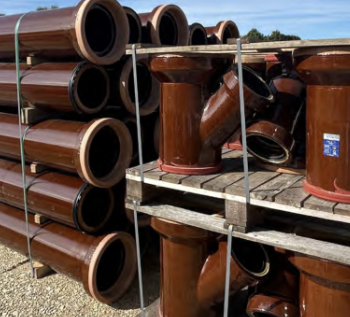
Why vitrified clay pipes are reclaiming their role in built projects.

Research by construction PR consultancy LMC published.
Roles and responsibilities of domestic clients

ACA Safety in Construction guide for domestic clients.
Fire door compliance in UK commercial buildings

Architect and manufacturer gives their low down.
Plumbing and heating for sustainability in new properties

Technical Engineer runs through changes in regulations, innovations in materials, and product systems.
Awareness of the Carbon Border Adjustment Mechanism
What CBAM is and what to do about it.
The new towns and strategic environmental assessments
12 locations of the New Towns Taskforce reduced to 7 within the new towns draft programme and open consultation.

Buildings that changed the future of architecture. Book review.
The Sustainability Pathfinder© Handbook
Built environment agency launches free Pathfinder© tool to help businesses progress sustainability strategies.

Government outcome to the late payment consultation, ECA reacts.
IHBC 2025 Gus Astley Student Award winners

Work on the role of hewing in UK historic conservation a win for Jack Parker of Oxford Brookes University.
Future Homes Building Standards and plug-in solar
Parts F and L amendments, the availability of solar panels and industry responses.
How later living housing can help solve the housing crisis

Unlocking homes, unlocking lives.
Preparing safety case reports for HRBs under the BSA

A new practical guide to preparing structural inputs for safety cases and safety case reports published by IStructE.
Male construction workers and prostate cancer

CIOB and Prostate Cancer UK encourage awareness of prostate cancer risks, and what to do about it.