





R (on the application of West Berkshire District Council and Reading Borough Council) v Secretary of State for Communities and Local Government
In July 2015, Mr Justice Holgate ruled in the case of R (on the application of West Berkshire District Council and Reading Borough Council) v Secretary of State for Communities and Local Government [2015] EWHC 2222 (Admin) Ref BAILII 31 July 2015.
In the landmark case at the High Court, Justice Holgate quashed government policy on affordable housing exemption thresholds, as a result of the which, planning guidance on planning obligations was amended to remove paragraphs 012-023. In addition, the government's vacant building credit policy was quashed.
In March 2014, the government launched a consultation to consider scrapping Section 106 charges for self-builders, homeowners, developers wanting to bring redundant buildings back into use and builders on small sites (10 units or 1,000 sqm gross floor area). It was claimed that these charges made such developments economically unviable.
The policy was introduced in November 2014 when Eric Pickles MP, Secretary of State for Communities and Local Government announced plans to make clear that Section 106 agreements should generally not be sought from the smallest housebuilders on sites of 10 homes or fewer, including self-build projects, extensions and annexes. In very rural areas, sites of 5 homes or fewer should not face the charge. See Section 106 exemption for more information.
At the time, Pickles said, ‘Small builders are being hammered by charges, which have undermined the building industry, cut jobs and forced up the cost of housing. By getting rid of these 5 and 6-figure charges, we will build more homes and help provide more low-cost and market housing.’
The vacant building credit (VBC) came into force through the publication of planning guidance, also in November 2014, and applied to any building that had not been abandoned that was brought back into lawful use, or was demolished to be replaced by a new building. The developer was offered a financial ‘credit’ equivalent to the existing gross floor space of relevant vacant buildings when the local planning authority calculated affordable housing contributions.
However, West Berkshire Council and Reading Borough Council challenged these changes arguing that process of consultation about the policy had been unlawful. Justice Holgate accepted that the government had failed to take into account "obviously material" considerations when promulgating a policy within a statutory context.
Justice Holgate said, “The beneficial purpose which Ministers intended their policy to serve was to overcome the "stalling" of development on small sites, an issue relating to land supply. In my judgment adverse effects on land supply were equally and obviously relevant to a proper weighing of the benefits (or rather the net benefits) of the proposed policy. There is no evidence to suggest that that exercise was carried out before the adoption of the policy in November 2014.”
Lead councillor for planning at Reading Borough Council, Tony Page, said, “This judgment is excellent news not just for Reading and West Berkshire councils but for all the people looking for affordable places to live. There is an acute and increasing need for affordable homes in Reading, which is demonstrated by the fact there are around 10,000 people on our housing waiting list, and the changes to the planning system would have made matters worse.”
A spokesman for the Department for Communities and Local Government said they would be seeking permission to appeal against the decision. In September 2015, the government was granted permission to appeal.
[edit] Related articles
Featured articles and news
Costs and insolvencies mount for SMEs, despite growth

Construction sector under insolvency and wage bill pressure in part linked to National Insurance, says report.
The place for vitrified clay pipes in modern infrastructure

Why vitrified clay pipes are reclaiming their role in built projects.

Research by construction PR consultancy LMC published.
Roles and responsibilities of domestic clients
ACA Safety in Construction guide for domestic clients.
Fire door compliance in UK commercial buildings

Architect and manufacturer gives their low down.
Plumbing and heating for sustainability in new properties

Technical Engineer runs through changes in regulations, innovations in materials, and product systems.
Awareness of the Carbon Border Adjustment Mechanism
What CBAM is and what to do about it.
The new towns and strategic environmental assessments
12 locations of the New Towns Taskforce reduced to 7 within the new towns draft programme and open consultation.
Buildings that changed the future of architecture. Book review.
The Sustainability Pathfinder© Handbook
Built environment agency launches free Pathfinder© tool to help businesses progress sustainability strategies.
Government outcome to the late payment consultation, ECA reacts.
IHBC 2025 Gus Astley Student Award winners
Work on the role of hewing in UK historic conservation a win for Jack Parker of Oxford Brookes University.
Future Homes Building Standards and plug-in solar
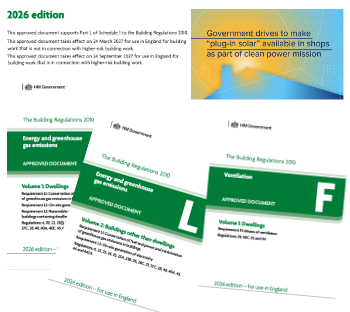
Parts F and L amendments, the availability of solar panels and industry responses.
How later living housing can help solve the housing crisis

Unlocking homes, unlocking lives.
Preparing safety case reports for HRBs under the BSA
A new practical guide to preparing structural inputs for safety cases and safety case reports published by IStructE.
Male construction workers and prostate cancer

CIOB and Prostate Cancer UK encourage awareness of prostate cancer risks, and what to do about it.