





Competent person

|
Contents |
[edit] Introduction
Generally, a competent person is one who has the necessary skills and ability to undertake a particular task, eg a competent golfer or salesperson. In construction however, the term also has three more specific meanings.
[edit] Building Safety Act 2022
Building Safety Act 2022, Section 35 refers to Industry competence thus:
"In Schedule 1 to the Building Act 1984 (building regulations) after paragraph 5B (inserted by section 34) insert—
Competence requirements
- 5C (1) Building regulations may, in relation to any work, impose competence requirements on—
- (a)any appointed person, or
- (b)any prescribed person.
- (2) A “competence requirement” is a requirement relating to—
- (a)the skills, knowledge, experience and behaviours of an individual;
- (b)the capability of a person other than an individual to perform its functions under building regulations.
- (3) The regulations may require an appointed person who is not an individual to give an individual acting under its control who has the appropriate skills, knowledge, experience and behaviours the task of managing its functions as an appointed person.”
[edit] Health and safety
The term 'competent person' can refer to a person who has the required skills, experience and knowledge to understand health and safety on site and so is able to recognise the hazards associated with particular tasks. They can then mitigate the effects of those hazards and allow the related tasks to be undertaken safely.
A competent person must not only be trained, skilled and knowledgeable but must also be able to apply these qualities to enable a task to be performed safely. It is important to consider competence in health and safety as an integral and vital component of worksite or workplace safety. It should not be an afterthought.
When conducting risk assessments, employers should be knowledgeable about the competence of their respective employees in order to provide them with the necessary training, instruction and supervision that each individual requires. Whatever measures are decided should be relevant to the workplace. A competent person should be appointed by the employer to ensure that relevant health and safety duties are met.
[edit] Self-certification
In the UK, ‘Competent person self-certification schemes’ (or ‘competent person schemes’) were introduced in 2002 to allow registered installers who are competent in their field to self-certify certain types of building work. For example, this can include air-tightness testing, plumbing and heating installers, electrical installers and cavity wall insulation installers.
The current schemes are listed at gov.uk.
For more information see: Competent person self-certifications schemes.
See also: Competence.
[edit] Related articles on Designing Buildings
- Building regulations.
- Competence.
- Construction health risks.
- Control of Substances Hazardous to Health (COSHH).
- ECA calls for stronger competency requirements in Building Safety Act.
- Environmental health.
- First aider.
- Health and safety at work etc act 1974.
- Health and safety consultant.
- Health and Safety Executive.
- Health and safety for building design and construction.
- Health and safety inspector.
- Health and safety policy.
- Injuries on construction sites.
- Near miss.
- Notification to HSE.
- Safety management.
- Safety.
- What is a hazard?
- Work at height regulations.
- Work at height rescue plan.
[edit] External references
Featured articles and news
Costs and insolvencies mount for SMEs, despite growth

Construction sector under insolvency and wage bill pressure in part linked to National Insurance, says report.
The place for vitrified clay pipes in modern infrastructure
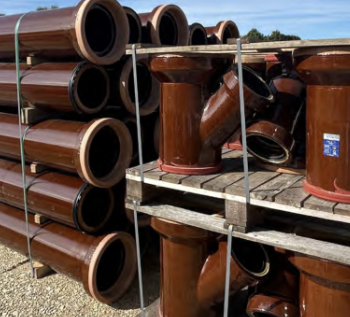
Why vitrified clay pipes are reclaiming their role in built projects.

Research by construction PR consultancy LMC published.
Roles and responsibilities of domestic clients

ACA Safety in Construction guide for domestic clients.
Fire door compliance in UK commercial buildings

Architect and manufacturer gives their low down.
Plumbing and heating for sustainability in new properties

Technical Engineer runs through changes in regulations, innovations in materials, and product systems.
Awareness of the Carbon Border Adjustment Mechanism
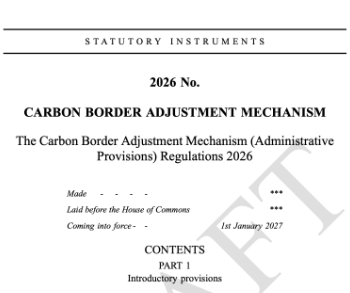
What CBAM is and what to do about it.
The new towns and strategic environmental assessments

12 locations of the New Towns Taskforce reduced to 7 within the new towns draft programme and open consultation.

Buildings that changed the future of architecture. Book review.
The Sustainability Pathfinder© Handbook
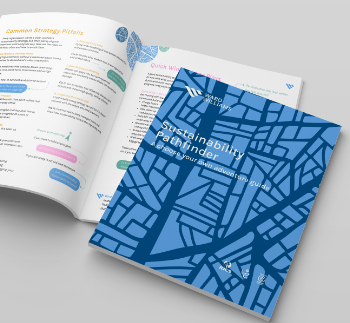
Built environment agency launches free Pathfinder© tool to help businesses progress sustainability strategies.

Government outcome to the late payment consultation, ECA reacts.
IHBC 2025 Gus Astley Student Award winners

Work on the role of hewing in UK historic conservation a win for Jack Parker of Oxford Brookes University.
Future Homes Building Standards and plug-in solar
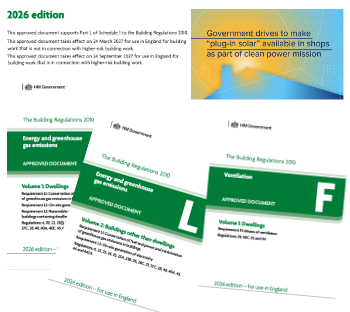
Parts F and L amendments, the availability of solar panels and industry responses.
How later living housing can help solve the housing crisis

Unlocking homes, unlocking lives.
Preparing safety case reports for HRBs under the BSA
A new practical guide to preparing structural inputs for safety cases and safety case reports published by IStructE.
Male construction workers and prostate cancer

CIOB and Prostate Cancer UK encourage awareness of prostate cancer risks, and what to do about it.